
What is PVD Coating?
What is PVD Coating in a nutshell?
PVD, an acronym for Physical Vapor Deposition, refers to a range of techniques for the deposition of thin-film coatings. PVD Coating deposition is a process carried out in a vacuum, in which a solid-state material (called target) is taken into the vapor phase so that it can reach the surface of the object to be coated (called substrate) where it condenses, forming the film.
This layer-by-layer deposition mechanism not only improves the adhesion of the film, but also allows a wide range of materials to be used to coat various types of substrates, from steel to brass, iron, and zamak (after treatment), as well as plastics and glass, making it possible to handle various types of substrates with the same facility.
Technologies for PVD Coating Processes
Sputtering, cathodic arc, and thermal evaporation (often simply called metallization) are the main processes used in industry. They differ in the way the constituents (atoms and ions) of the vapor phase are extracted from the target and the energy that is applied to them.
The choice of one over another method is determined by the properties to be achieved, in terms of film compactness, adhesion and color, and the type of material to be deposited.
The most important characteristics of PVD are:
- A significant hardness of the surface coat,
- Resistance to scratches and abrasions
- A high level of wear persistence.
What role does PVD have in industrial coatings?
These methods have been used extensively since the late 1960s to create material layers for applications in both research and industry, ranging from electronics to mechanics, from construction to fashion, because they allow the composition and thickness of the coating to be precisely adjusted, and thus to obtain systems with special and controlled characteristics.
The market demands innovative products of the very high standard, which is the reason why PVD continues to find more and more applications in the field of industrial coatings. However, its diffusion is limited, especially in Italy, due to a lack of awareness of the technology, which is perceived as a new development despite its decades of history.
How the PVD process works
Cleaned or pretreated parts and the frame on which they are placed are placed in the chamber. After reaching the ideal vacuum for deposition, the sources (the devices used to extract the target atoms) are turned on.
By changing the gas flow and the rate at which atoms are extracted from the target, it is possible to obtain materials with different compositions, and thus with different physical characteristics and colors. Usually, 0.2 to 3 µm of material is deposited (in electroplating, 5 to 20 microns thick is applied), depending on if the coating is to be decorative or functional. This will affect the duration of the process, which will range from a few minutes to several tens of minutes, also depending on the type of coating desired and the technique used. After that, the air is sent back into the chamber and the pieces can be removed, with no additional treatment required.
Disposal operations are also unnecessary because this technology is eco-friendly and produces no waste.

PVD Finish Materials
PVD finish offers endless possibilities, as nearly any material can be deposited. Generally, titanium and chromium are used as a base because of their strong corrosion resistance properties, but pure metals, alloys, nitrides, carbs and oxides, as well as glass and ceramics, can also be deposited through this technology.
This flexibility allows PVD depositions to be used in a wide variety of application fields.
What are the PVD coating applications?
PVD for Decorative Field
In the decorative industry, PVD is used to improve the aesthetic appearance of various products. This technology allows for a wide range of colors and finishes, from glossy to matte, making products more attractive and durable. In fact, the PVD finish is enduring, resists wear and tear, and retains its original luster and appearance over time.
PVD for Functional Field
PVD is widely used in the functional sector to improve the technical properties of materials. Products coated in PVD materials exhibit increased surface hardness, reduced friction and increased wear resistance, which promotes an increase in their efficiency and durability. It is also a highly biocompatible coating, suitable for instrument and prosthesis plating in the Biomedical field.
PVD for Research and Development Field
In the field of research and development, PVD is essential for the deposition of innovative materials and the development of new technologies. The ability to deposit a wide range of materials, from pure metals to alloys and from nitrides to carbides, makes PVD a versatile technology for advanced materials research, opening new frontiers in various fields from biomedicine to energy.
What are the main Properties of PVD Finish?
PVD finish is often used for protection, shielding, or increasing reflectivity. These properties are essential for optical applications such as mirrors for focusing and deflecting light beams and signals, automobile headlights, or in electronics. This process is also applicable to plastic and glass, materials that can be easily shaped so that the advantages of a metal surface can be combined with objects of complex shapes. This explains the increasing use of PVD chrome plating in fields such as handles and interiors for the automotive industry, caps and containers for cosmetics, faucets and utensils for home furnishings, and for accessories such as buckles, hooks, buttons, and costume jewelry for the fashion industry.
In such cases, it is not uncommon to use PVD and PECVD technologies to add an additional thin protective layer of glass to improve corrosion and scratch resistance or to add bactericidal, antiviral or anti-fingerprint properties.
Since the process consists in casting materials onto the substrate that need to be coated, the shape of the object must meet certain requirements. In fact, it is not possible for PVD to coat deep, narrow holes or to ensure perfect uniformity over internal or difficult-to-access areas. This problem is usually overcome by hanging the substrates on rods and mechanically rotating them around different axes so that they pass in front of material sources, always showing a different area.
PVD is widely used in the production of machining and cutting tools due to the fact that nitride and carbonitride-based coatings are easily obtainable and are characterized by extreme hardness and high adhesion, properties that improve the efficiency and extend the durability of these mechanical components.
PVD Colors
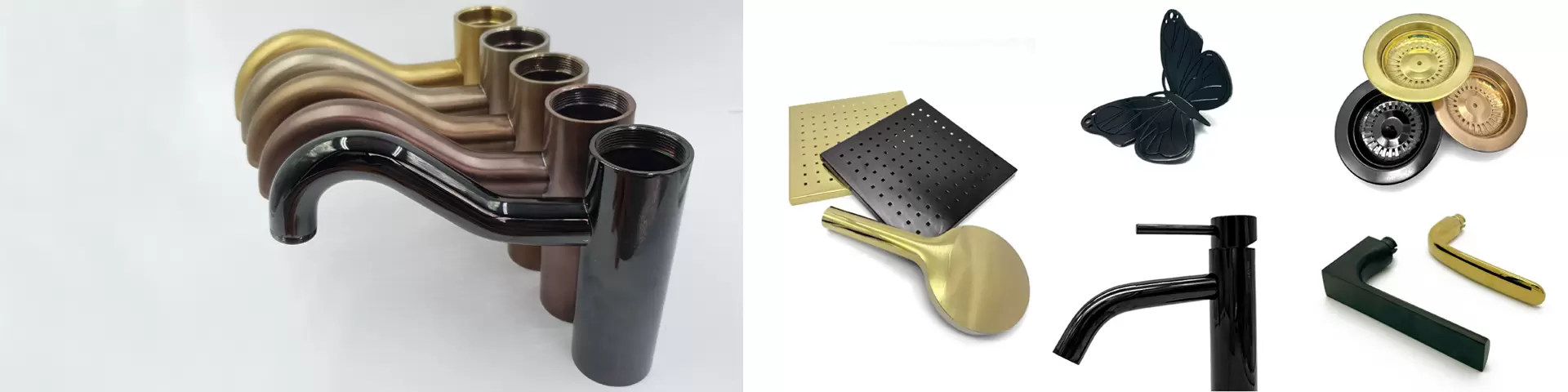
Moreover, the possibility of generating composite materials allows the creation of colors that would otherwise require the use of precious minerals such as silver, and new colors and shades can be generated to better match current trends. In the decorative field, straw yellow, pitch black, chestnut, or rose gold are new colors that combine elegance and innovation with the charm and cool touch that only metal can offer, while maintaining its luster and resistance to scratches and abrasions. The versatility and quality of PVD coatings are certainly among the most important advantages of this type of application.
What are the PVD coating benefits?
With PVD technology, highly durable coatings and special colors can be achieved through a highly sustainable process.
No polluting solutions are used in PVD processes and the metals used are pure, so there are no environmentally harmful substances released into the atmosphere during deposition, making it a sustainable technology in line with the growing awareness of ecological issues. The eco-compatibility of the process also allows PVD to be used in the medical-health field or for the coating of kitchen equipment (cutlery, trays, appliances), two sensitive areas where prolonged contact with people makes it necessary to employ treatment technologies that do not use toxic materials.
PVD Composite Materials
Another strength of PVD technology is the possibility of producing composite materials (nitrides, carbides, oxides), by introducing in chamber, gases that combine with the atoms that are about to be deposited.
Doing so produces coatings with superior characteristics, such as high nitride resistance to wear and scratches. It also allows to produce special colorsthat cannot be achieved with other technologies. gold PVD and black PVD in particular. can achieve degrees of color intensity that no other coating solution can offer.
It is precisely for these reasons that PVD is sometimes used as a complementary technology to other treatments. For example, in some cases, a galvanic pretreatment is applied to achieve a glossy surface and increase corrosion resistance, after which a thin PVD layer is applied to provide hardness and the desired color shade, from straw yellow to gold, chrome to glossy black, light pink and cherry brown.
PVD Coating: Plastics
Another example is plastic: a UV coating prepares the substrate to receive the PVD film, enabling a chrome-like finish that, until recently, seemed achievable only through hexavalent electroplating. This technology not only provides a more eco-friendly alternative to traditional electroplating by reducing the use of hazardous chemicals, but it also ensures greater uniformity and corrosion resistance of the coating. Moreover, combining PVD with UV coating allows for customizable aesthetic effects, such as matte or satin finishes, broadening the design possibilities for industries like automotive, consumer electronics, and others. With these advancements, companies can now meet increasingly stringent environmental regulations without compromising the quality of the final product.
100% Biocompatible Technology
PVD is a type of treatment that is making its way into the surface finishing industry, adding value to the entire production chain. Many industries have already opened up to PVD by replacing galvanic coloring, leading to large volumes of investment in the sector. The goal is to stimulate the use of this technology to meet the criteria of new REACH regulations and help the production chain to become truly green.
Knowing the basics of PVD and the different deposition technologies becomes essential to fully understand the process that best suits one’s needs, Kenosistec’s role is also to support companies during decision-making processes, to find the ideal solution to individual production needs.
Would you like to find out more about Kenosistec PVD technologies?